
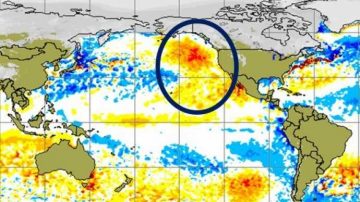
Sea temperature in the North Pacific during 2014. The intense red areas indicate above average water temperatures. Photo ©️ The Weather Network
Late in 2013, a large mass of warm water was detected in the eastern North Pacific off the west coast of North America. This warm water mass, which has become known as “The Blob” or “The Warm Blob”, persisted for about two years. Reminiscent of 1958’s schlock horror file, The Blob starring the late Steve McQueen, the Warm Blob was characterized by low nutrient levels, which affected the entire food chain, from phytoplankton to marine mammals, but its short-term or long-term effects on fish distributions are unknown.
The coast of British Columbia represents an important geographic region, as it straddles the boundary between two marine zoogeographic provinces: the Oregonian Province, which extends from the subtropical eastern North Pacific approximately to the Queen Charlotte Islands, and the Aleutian Province, which extends from the Queen Charlotte Islands north to the Arctic waters of the Bering Sea. This region has recently become more significant, as the Warm Blob was centred off the British Columbia coast.
To survey collections for unusual records of fishes related to the occurrence of the Warm Blob, NMFS/AFSC fishery biologists and ichthyologists James Orr and Duane Stevenson visited the Beaty Biodiversity Museum, which holds a collection of more than 850,000 specimens, collected from the 1950s to the present. Their goal was to survey select groups of fish species for which patterns of distribution may have changed as a result of the Warm Blob, or may be expected to change in response to warming climate scenarios. The taxonomic groups surveyed emphasized those including commercially managed species, such as the Rockfishes, Flatfishes, and Skates, as well as the taxonomically problematic groups of Eelpouts, Snailfishes, and Lumpsuckers.
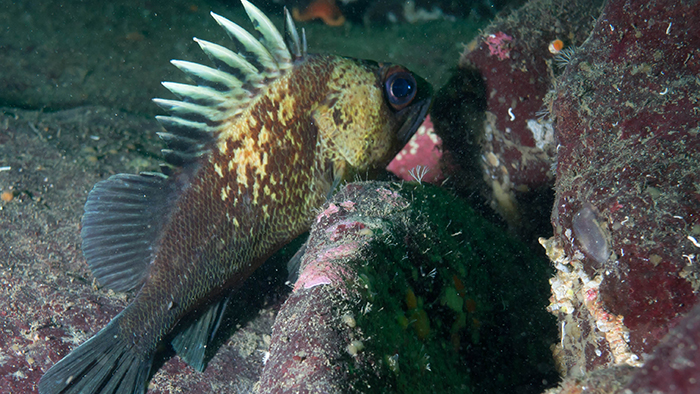
Quilled Rockfish at Saturnina, Gulf Islands, BC, Canada. Photo ©️ Ratha Grimes
During their time at UBC, they examined 568 lots totaling 1862 specimens. Nearly all existing species identifications were confirmed; however, 75 lots with 182 specimens were re-identified and 33 lots of 49 skates that did not have identifications were identified.
Although this investigation did not reveal significant changes in the known distributions of any of the species examined, the geographic data associated with these specimens will help resolve the distributions of many species on a finer scale, facilitating the recognition of any future distribution shifts. The Warm Blob may have moderated, but the elevated sea surface temperatures and oceanographic conditions associated with its formation and persistence may provide a glimpse into the future of a warming North Pacific Ocean. If this warming trend continues, we may expect to see changes in the distribution of marine organisms at all trophic levels. As these changes progress, we can expect to see transitions in the placement of major marine zoogeographic boundaries such as the Aleutian/Oregonian line off the coast of British Columbia. Our ability to detect changes in these faunal boundaries, and thus our ability to document and react to those changes, will depend in large part on the depth and breadth of baseline biological collections’ data gained from investigations such as this one.